
The NI weekly market report

28 July 2025
28 July 2025
Grains
UK feed wheat futures fell last week (Friday to Friday), closing near the 20-day moving average. The relative strength index (RSI) increased from 40 to 49, indicating momentum. Prices may be on the way to finding further direction, but the market lacks a clear upward drive.
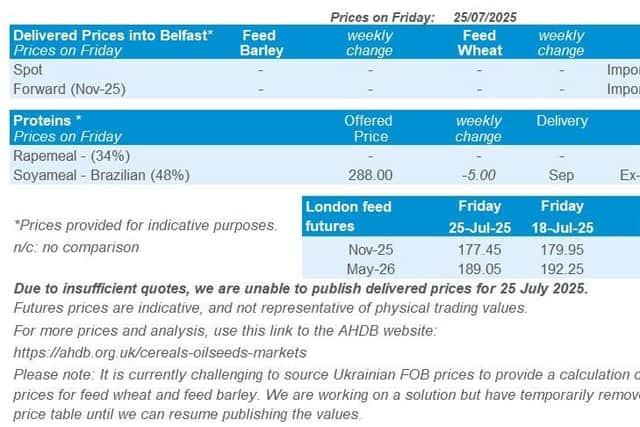
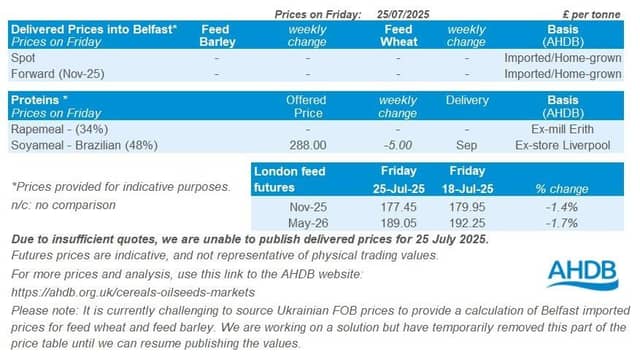
Global wheat futures eased last week (18-25 July), putting pressure on domestic prices. UK feed wheat futures (Nov-25) fell by £2.50/t (1.4%), closing at £177.45/t. Paris milling wheat and Chicago wheat futures (Dec-25) also fell by 3.2% and 1.5% respectively.
The ongoing harvesting campaign in the Northern Hemisphere continued to weigh on markets last week, offsetting support from a stronger-than-expected US weekly export sales report.
As of 21 July, FranceAgriMer reported that 86% of soft wheat had been harvested, compared to 37% in 2024 and a five-year average of 59% for the same period. In contrast, the harvesting campaign in the Black Sea region is behind last year's pace.
The rate of wheat exports during this harvest period is a key factor in determining global prices. So far, export volumes from the EU and the Black Sea region are currently below last year's figures, while US exports are broadly in line with both last season and the five-year average.
On the export side, the competition between the Black Sea region and EU is increasing due to the minimal price difference by origin.
The USDA's export sales report for the week ending 17 July showed net wheat sales of 712.2 kt, exceeding the top of trade expectations. Maize export was at 733.9 Kt, sitting at the upper end of estimates.
In a notable geopolitical development, the US and EU presidents announced a new trade deal in western Scotland over the weekend. As part of the agreement, the US will apply a 15% import tariff on selected EU goods.
There is still a risk of adverse weather conditions for grains in the Northern Hemisphere. Rain during harvest in Germany could affect wheat quality, while spring wheat conditions in the US and maize conditions in the EU are key areas to watch in the near future.
Meanwhile, the USDA rated 74% of the US maize crop as being in good to excellent condition as of 20 July. This represents an increase on last year's figure of 67% and is the highest rating at this stage since 2016. The possibility of US maize production reaching a historically high level of 400 Mt in the 2025/26 season is a key factor in global supply outlooks.
Rapeseed
Last week (Friday–Friday), Paris rapeseed futures (in £/t) finished just above the 20-day moving average, closing at just over £423/t. The relative strength index (RSI) increased this week from 39 to 56 showing an increase in momentum in the market.
AHDB’s second harvest progress report was released on Friday 25 July, capturing results up until the 23 of July. The UK oilseed rape harvest is 54% complete, lagging behind last year’s pace, but average yields are strong at 3.76t/ha, 21% above the five-year norm, with notable gains in Eastern and South Eastern regions. Quality is reportedly good, with oil content averaging 45%.
On the markets, Paris rapeseed futures (Nov-25) closed at €485.75/t on Friday, up €1.25 (0.3%) on the week after dipping to €480.75/t on Monday before recovering towards the end of the week.
In contrast, US soyabean prices continued to face downward pressure over the past week amid weather concerns. Across the Midwest, traders feared intense heat could damage yields, but midweek showers helped ease crop stress. Chicago soybeans (Nov-25) closed 1.4% lower from Friday to Friday. The US soyabean crop was rated at 68% in good or excellent condition as at 20 July. This is down 2 percentage points on the previous week and in line with the same point last year but remains well above the 5-year average of 60%.
In Canada, canola futures have continued to trade between CAD$690/t and CAD$700/t struggling to break past this bound since early July. Canadian weather remains beneficial for crop development and support previously seen in the wider oilseed complex has also subsided.
The EU reported soyabean and rapeseed imports were down 32% and 36% respectively on a year ago. According to European Commission projections for 2025/26, imports of rapeseed are expected to fall to 5.8 Mt (-22.2%) amid stronger production domestically and little growth in demand.