
The NI weekly market report
01 December 2025
Grains
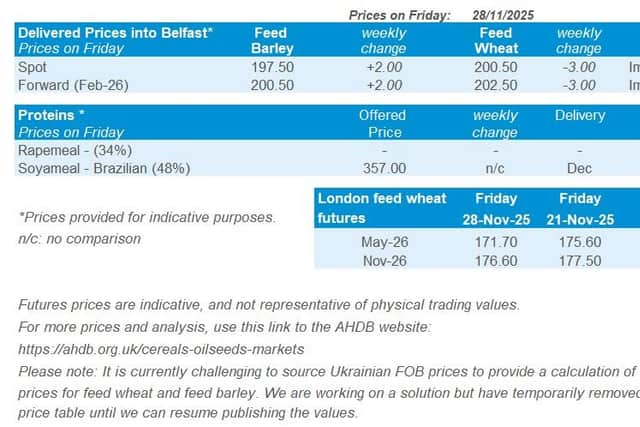
Last week, UK feed wheat futures (May-26) fell below the previous support level of £173/t. The next nearest support level is now £167/t.

The relative strength index (RSI) eased to 32 from 52 the previous week, indicating a significant decrease in price. RSI is now approaching the oversold zone.
Market drivers
UK feed wheat futures fell last week, with the May-26 contract closing at £171.70/t on Friday, down £3.90/t (2.2%) across the week. New crop futures (Nov-26) contract fell by £0.90/t (0.5%) to £176.60/t. The ample global supply of wheat is putting downward pressure on prices. The strengthening of sterling against the US dollar and euro over the past week has contributed to the downward trend of domestic wheat prices.
Domestic prices broadly followed global market movements. Paris milling wheat and Chicago wheat futures (May-26) decreased by 2.3% and 0.3%, respectively across the week. In an increasingly competitive landscape for the world's wheat exporters, the impact of currencies is growing. Last week, the weaker US Dollar Index put additional pressure on European futures and limited the fall in Chicago.
For old crop, the European Commission increased EU-27 estimate of soft wheat production by 0.8 Mt for 2025/26 to 134.2 Mt last Thursday, given the good growing season. For harvest 26, the MARS European crop monitor showed that the weather is currently generally favourable for 2026 winter crops across Europe.
The USDA's Crop Progress (to Nov 23) reported that 48% of the US winter wheat crop was rated good-to-excellent, up 3% from last week, but behind last year’s rating of 55% The next Crop Progress report will now be published in April 2026, the market will continue to closely monitor US weather as the winter wheat crop enters dormancy.
Argentina's 2025/26 wheat harvest is expected to reach a record 25.5 Mt, up from a previous estimate of 24.0 Mt, this is due to higher-than-expected yields, according to data released by the Buenos Aires Grains Exchange last Thursday. This Argentinian crop will continue to cap any significant global price gain, given Argentina’s exportable surplus.
Last week, Chicago maize futures May-26 showed an increase of 2.5% due to competitive prices and export demand for US-origin. Maize prices were also supported by the delayed harvest of maize in Ukraine and reduced production prospects for the first Brazilian maize crop.
In the geopolitical arena, the results of negotiations between Ukraine and Russia regarding a peace agreement could also be in the spotlight for market participants, at the moment agreements have not been met.
Rapeseed
In £/t terms, May-26 Paris rapeseed futures increased last week (21 November – 28 November), but closed below the 20-day moving average near £421/t.
The RSI fell from 57 to 45, signalling weaker momentum as it moved closer to the oversold zone.
Market drivers
The oilseeds complex strengthened last week. Paris rapeseed futures (May-26) rose €3.75/t (0.8%) to close at €478.75/t, supported by firmer vegetable oil markets. Chicago soya oil and Winnipeg canola futures (May-26) gained 2.7% and 1.5% respectively. A slight increase in Brent crude oil futures and position adjustments ahead of the US Thanksgiving holiday on Thursday (27 December) also added support. However, ample global supplies continue to cap upside potential.
Chicago soyabean futures (May-26) rose by 1.1% on the week. Demand from China underpinned the market, with reports of around ten cargoes of US soyabeans purchased following a call between Trump and Xi. However, it remains uncertain whether sales will reach the 12 Mt by January 2026 referenced by the White House, due to strong competition from Brazil. There were also reports of China rejecting 69 Kt of Brazilian soyabeans after they failed inspection.
Across the EU, fundamentals remain bearish, with higher production forecasts and good crop conditions. Expana forecasts EU rapeseed production at 20.8 Mt in 2026/27, up 1.5% year-on-year. The EU’s crop monitoring service MARS reports that winter crop sowing is progressing well, with cereals and rapeseed showing good early establishment. In South America, planting progress remains mixed. In Brazil, soyabean planting for 2025/26 is 86.9% complete (to 28 Nov), slightly behind last year and the five-year average. Weather remains mixed, with irregular rainfall and periods of extreme heat raising concerns for crop development.