
Northern Ireland weekly market report
Northern Ireland weekly market report
27 July 2026
Grains
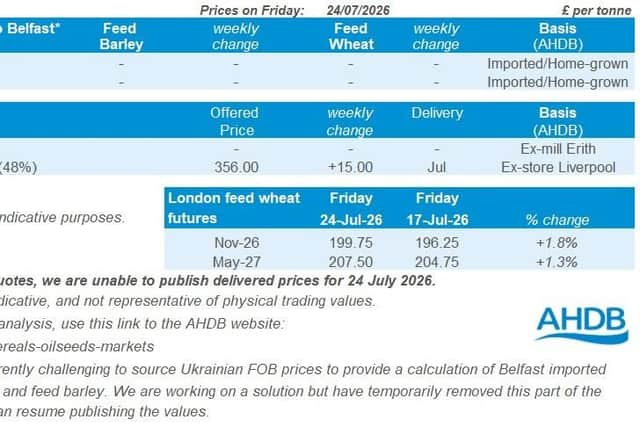
There was continued support in the domestic grain market as Nov-26 UK feed wheat futures (green line with markers, Figure 1) gained £3.50/t (1.8%) last week to close Friday at £199.75/t. The November 2026 hit a contract high on Wednesday closing at £207.00/t, breaking the £200.00/t psychological threshold, however, soon came back down.

The Relative Strength Index (RSI) decreased from 76 on 17 July to 75 on 24 July. The RSI is now in the overbought zone (above 70). This can trigger a pause or retreat in prices if there isn’t further supportive market news, but further news can still push prices higher.
Market drivers
Markets remained volatile, with continued bullish support for global grains early last week as Black Sea disruption and European heatwave concerns outweighed ample supply. Geopolitics and weather drove speculative buying into grains, but global grains markets reduced on Friday from profit‑taking and positioning ahead of the weekend. Further to that, on Friday afternoon reports came in that Ukraine was discussing ways to protect vessels using its Odesa‑region ports for exporting grains adding further pressure, which was later denied on Friday evening. However, this added selling pressure on Friday, leaving some grain markets down week‑on‑week.
The main market driver is continued disruption in the Black Sea, as further attacks on ports and commercial vessels deter shipping calls and push war‑risk insurance and freight costs higher. With both Ukraine and Russia having harvested significant grain volumes, any prolonged or complete halt to Black Sea exports would remove a large share of global supply from the market and provide strong support to prices. These events are evolving daily which is adding to volatility.
French maize crop ratings deteriorated further in the week to 20 July as a severe heatwave affected the EU’s largest grain producer, with FranceAgriMer reporting that just 38% of the maize area was in good or excellent condition by 20 July, down from 40% a week earlier and 69% a year ago. Maize remains the most weather‑exposed cereal in France as it is still in its critical growing phase, while winter crop harvests were largely complete, with soft wheat and spring barley 99% cut by Monday and the durum harvest finished.
Russia’s 2026 grain crop is forecast at 139 Mt, including 90 Mt of wheat, according to consultancy IKAR Both grain and wheat production forecasts were cut due to difficult weather in Siberia and the Urals, even though conditions in the south remain good. The agency expects Russia to export 58.5 Mt of grain in 2026/27, of which 44.5 Mt would be wheat.
Grain markets are likely to remain volatile in the near term, but supply-side fundamentals are not currently supportive of a sustained rally. Brazil’s safrinha crop is being harvested without major issues, and US weather is not yet tight enough to materially threaten maize production, despite a short-lived heatwave in the Midwest this week.
Rapeseed
The Paris rapeseed futures Nov-26 contract increased by 0.5% from Friday 17 to Friday 24 July, closing at £470.27/t (Figure 2).
The relative strength index (RSI) is 63, nearing the overbought zone (70).
Market drivers
Oilseeds were broadly supported across the week, with the rally in crude oil and the intensifying Black Sea conflict providing the main tailwinds. Geopolitics remains the dominant driver for oilseeds and vegetable oils, and last week’s moves were a clear reflection of that, given oilseed use in the production of global biofuels.
Crude oil hit its highest point last Thursday in nearly two months, after Yemen’s Houthis claimed attacks on two Saudi tankers in the Red Sea, adding to global supply disruptions following a near‑halt in trade through the Strait of Hormuz. However, oil did come back down on Friday amid reports that China was pushing to restart stalled US-Iran peace talks. Nearby Brent crude oil closed at $96.78/barrel on Friday, still posting a weekly gain of $8.68/barrel as geopolitical risk remained elevated. From a supply side, focus is now on Canadian canola production as temperatures recently have increased in the Prairies. However, its been reported that Canada's crop outlook remains highly favourable according to EarthDaily’s analysis of satellite and agronomic data. Mid-season crop conditions across the Prairies are reported as the best in around a decade. Beneficial spring rainfall has replenished soil moisture following several years of drought, supporting strong crop development and leaving many areas with sufficient moisture reserves to sustain crops through to harvest. Warm summer temperatures have also accelerated crop growth, underpinning expectations for strong canola yields. This is a key watchpoint for the market as this Canadian crop will influence rapeseed support or discount relative to other oilseeds. In the near term, the oilseed market remains well supplied, underpinned by expectations for a large US soyabean crop. However, crude oil is likely to remain the primary driver of oilseed price direction. For example, crude oil markets came under pressure this morning after President Trump paused planned strikes on Iran, raising hopes of a diplomatic resolution and a potential de-escalation of tensions in the Middle East. As a result, developments in energy markets are expected to be the key influence on rapeseed prices over the coming week.